CT Scan vs MRI in Pakistan | Detailed Comparison Guide
When your doctor recommends medical imaging, one of the most common questions patients ask is: “Should I go for a CT scan or an MRI?” Both tests provide valuable insights into what’s happening inside the body, but they work differently and are used for different medical conditions.
At Northern Interventional Radiology Services (NIRS) Abbottabad, patients from Islamabad, Rawalpindi, KPK, and across Pakistan have access to both CT scans and MRI scans using state-of-the-art equipment. Choosing the right test depends on the type of condition, the area of the body being examined, and the level of detail required.
This blog will help you understand the differences between CT scans and MRIs, when each is recommended, and how they can help doctors make accurate diagnoses.
What is a CT Scan?
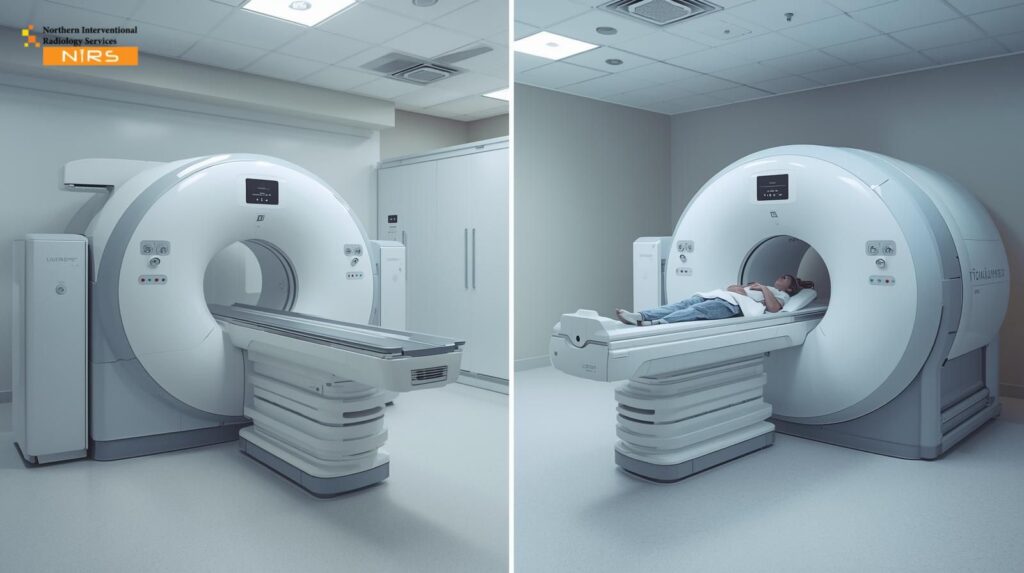
A CT scan (Computed Tomography) uses X-rays and computer technology to create detailed cross-sectional images of the body. Think of it as taking multiple X-rays from different angles and combining them into 3D images.
Key Uses of CT Scans:
- Head Injuries & Brain Bleeds: Detect internal bleeding, stroke, or trauma quickly.
- Lung & Chest Conditions: Identify infections, tumors, or clots.
- Bone & Joint Problems: Reveal fractures, bone injuries, and spinal issues.
- Cancer Detection: Locate tumors and check their spread.
- Emergency Cases: CT scans are fast, making them ideal in urgent situations.
At NIRS Abbottabad, advanced CT technology ensures high-resolution images with minimal radiation exposure.
What is an MRI?
An MRI (Magnetic Resonance Imaging) uses powerful magnets and radio waves to produce highly detailed images of organs, tissues, and joints—without radiation.
Key Uses of MRI:
- Brain & Nervous System: Detect tumors, multiple sclerosis, or nerve disorders.
- Spinal Cord & Discs: Reveal slipped discs, nerve compression, or spinal injuries.
- Joints & Soft Tissues: Best for knees, shoulders, ligaments, and tendons.
- Heart & Blood Vessels: Assess blood flow and detect abnormalities.
- Pelvic & Abdominal Conditions: Examine liver, kidneys, uterus, or ovaries.
At NIRS Abbottabad, MRI scans are performed with international-quality technology, ensuring accuracy and patient comfort.
Which Imaging Test Should You Choose?
The choice between a CT scan and MRI depends on several factors:
- Nature of the Condition
- CT is better for bones, chest, trauma, and emergency cases.
- MRI is better for soft tissues, nerves, brain, and joints.
- Urgency
- In emergencies (head injury, internal bleeding), CT scans are quicker.
- For detailed studies (like brain tumors), MRI is the gold standard.
- Radiation Concerns
- CT scans involve low radiation exposure.
- MRI uses no radiation—safer for children and pregnant women (in many cases).
- Cost & Accessibility
- CT scans are generally more affordable and widely available.
- MRI scans, while more detailed, may cost slightly more and take longer.
👉 At NIRS Abbottabad, patients don’t need to worry about choosing. Specialists carefully evaluate symptoms and recommend the most suitable test.
Patient Experience at NIRS Abbottabad
Patients often worry about claustrophobia, safety, or pain during scans. At NIRS Abbottabad:
- Scans are non-invasive and painless.
- Patient comfort is prioritized with modern machines and shorter scan times.
- Reports are interpreted by experienced radiologists for accurate diagnosis.
- Consultation ensures patients understand why a CT or MRI is recommended.
This builds trust and confidence, especially for first-time patients.
Benefits of Advanced Imaging at NIRS
- ✅ High-resolution scans for accurate diagnosis.
- ✅ Low-dose CT technology to minimize radiation.
- ✅ MRI without radiation for safer imaging.
- ✅ Expert interventional radiologists available for treatment planning.
- ✅ Central location in Abbottabad—accessible for patients from Islamabad, Rawalpindi, and KPK.
When to See a Doctor for a CT or MRI
Patients should seek imaging if they have:
- Persistent headaches, dizziness, or seizures.
- Chest pain, unexplained cough, or shortness of breath.
- Back pain, numbness, or nerve-related symptoms.
- Joint injuries or swelling that doesn’t heal.
- Suspected tumors or unexplained weight loss.
Early diagnosis can prevent complications and guide effective treatment.
Conclusion
Both CT scans and MRIs are powerful diagnostic tools that help doctors understand medical conditions with precision. While CT scans are faster and best for emergencies, MRIs provide unmatched detail for soft tissues, nerves, and complex conditions.
At NIRS Abbottabad, patients receive the right test at the right time—guided by expert radiologists and supported by advanced imaging technology. Whether you need a quick CT scan after an injury or a detailed MRI for a neurological condition, NIRS ensures safe, accurate, and patient-friendly imaging services in Pakistan.
👉 If your doctor has recommended a scan and you are unsure which one to choose, book a consultation with NIRS Abbottabad today. Our specialists will guide you to the best option for your health.